GeForce RTX 30 Series

NVIDIA GeForce RTX 3050

NVIDIA GeForce RTX 3050
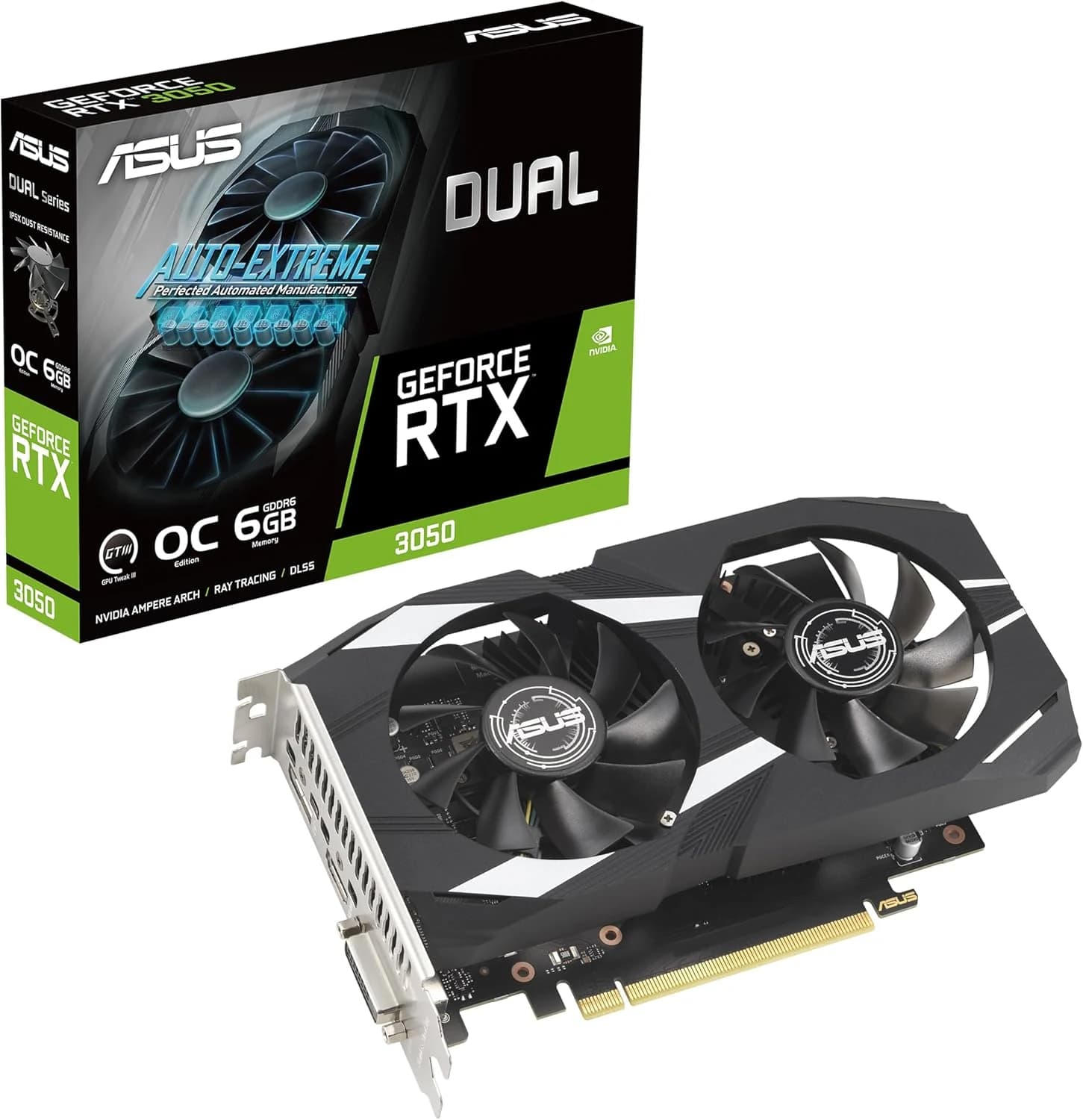
Representative ASUS product image. Board design, dimensions and power limits can vary by model.Source coverage for this specification group is incomplete.

At a glance

Launch date
Architecture
Ampere
CUDA cores
2,560
Memory
8 GB GDDR62 published configurations
TGP
130 W

Hardware specifications

Compute

CUDA cores
2,560

Clocks

Base clock
1,550 MHz
Boost clock
1,780 MHz

Memory

Configuration 1 Capacity
8 GB
Configuration 1 Memory type
GDDR6
Configuration 1 Bus width
128-bit
Configuration 1 Bandwidth
224 GB/s
Configuration 2 Capacity
6 GB
Configuration 2 Memory type
GDDR6
Configuration 2 Bus width
96-bit
Configuration 2 Bandwidth
168 GB/s

Power

TGP
130 W
Recommended PSU
550 W
Power connectors
1x PCIe 8-pin

Physical

Interface
PCI Express Gen 4
Display connectors
1x HDMI 2.1, 2x DisplayPort 1.4a

Before you buy

Fit and power planning

Use the published values below as a starting point then verify the exact retail card, case and power supply you plan to use.

TGP
130 W
Recommended PSU
550 W
Power connectors
1x PCIe 8-pin
Display connectors
1x HDMI 2.1, 2x DisplayPort 1.4a

Confirm the exact partner-board specification before buying. Cooler size, case clearance, connector placement and power limits can differ from the published reference values.

Measured evidence

Market and rendering evidence

Historical launch pricing for NVIDIA GeForce RTX 3050 preserves source terms such as USD, MSRP and SEP. It is shown separately from one workload-specific community benchmark.

Historical launch price

Initial launch status
Verified
Currency
USD
Verified date
Event kind
Initial launch
Event date
Market
United States
Scope
Original 8 GB model $249
Price basis
Starting price
Source wording
Starting at

Source

Step Up to RTX with GeForce RTX 3050 on January 27, Starting at $249

NVIDIA - Published - Retrieved

Blender Cycles rendering

1,331.7 estimated samples per minute

Backend
OptiX
Confidence
Established
Submission count
129 submissions
Cohort
Blender 4.5.0 on Windows using OptiX across the standard Blender Benchmark scenes

This is a Cycles rendering community median in estimated samples per minute. It is not gaming FPS or an overall GPU rating.

Open Blender Open Data source

Retrieved

Open Blender Open Data methodology

Evidence record

Sources and verification

Specifications for NVIDIA GeForce RTX 3050 were checked against the linked source material. Last verified .

The RTX 3050 image context comes from a reviewed owner-supplied local ASUS manufacturer image and is not asserted by the NVIDIA specification sources. NVIDIA publishes two desktop configurations. The original standard 8 GB column has 2560 CUDA cores, a 1.55 GHz base clock, a 1.78 GHz boost clock, 130 W Graphics Card Power, 550 W required system power and one PCIe 8-pin connector. The 6 GB card has 2304 CUDA cores, a 1.04 GHz base clock, a 1.47 GHz boost clock, 70 W Graphics Card Power, 300 W required system power and no supplementary connector. NVIDIA says the 6 GB card became available on 2024-02-02 and separately calls its 70 W value TGP. The scalar compute, clock and power fields store the original standard 8 GB values because the current schema cannot attach them per memory configuration. An OEM exception attached to the 8 GB column has 2304 CUDA cores, a 1.51 GHz base clock and a 1.76 GHz boost clock. NVIDIA publishes no reference length, width or slot width and no PCIe lane width for either desktop capacity.

Where to buy

NVIDIA GeForce RTX 3050

Confirm the selected model, seller, condition, delivery region and checkout total on the retailer's site. A listing is not a compatibility recommendation.

MSI RTX 3050 Ventus 2X OC 6GB

Linked variant: 6 GB GDDR6

Partner-board listing. Clocks, cooling, dimensions, connectors and power limits can differ from the reference specifications on this page.

Affiliate link. As an Amazon Associate I earn from qualifying purchases.

View on Amazon