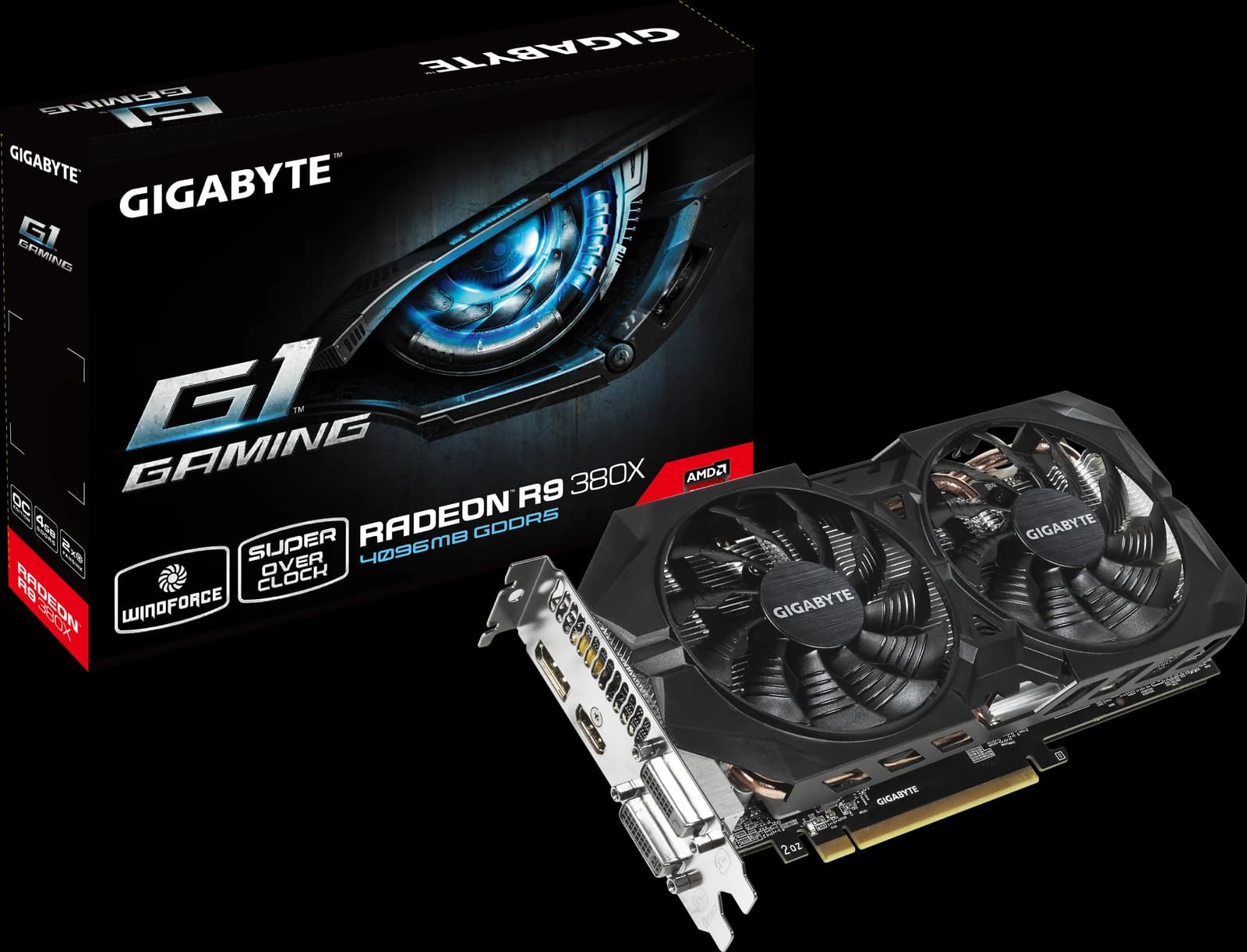
Representative GIGABYTE product image. Board design, dimensions and power limits can vary by model.Source coverage for this specification group is incomplete.
At a glance
Launch date
Architecture
Graphics Core Next
Compute units
32
Memory
4 GB GDDR5
Hardware specifications
Compute
Compute units
32
Stream processors
2,048
Clocks
Boost clock
970 MHz
Memory
Capacity
4 GB
Memory type
GDDR5
Bus width
256-bit
Bandwidth
182 GB/s
Measured evidence
Market and rendering evidence
Historical launch pricing for AMD Radeon R9 380X preserves source terms such as USD, MSRP and SEP. It is shown separately from one workload-specific community benchmark.
Historical launch price
Initial launch status
No verified initial launch price
Currency
USD
Verified date
No defensible first-party initial USD price was found.
Specifications for AMD Radeon R9 380X were checked against the linked source material. Last verified .
AMD Radeon R9 380X uses the official ASUS November 19 2015 announcement date because AMD's later introduction summary has no exact day. It must not be described as verified same-day retail availability. AMD's current support page prints 64-bit but AMD's own 2016 results release and GIGABYTE both publish 256-bit, so the canonical interface is 256-bit. The support page's 182 GB/s value is retained without increasing its precision. Graphics Core Next is supported at the AMD R9 300 family level and has medium confidence for this exact model. The image context comes from the reviewed owner-supplied local GIGABYTE image at resources/Graphics Card Photos/GIGABYTE GC/61. R9 380X.png and is not asserted by the web specification sources. represented_model stays absent because the manifest verifies box-level GPU identity rather than an exact board SKU.
The live official ASUS support listing displays this announcement title with date 2015/11/19. The canonical article URL returned HTTP 500 during review. The date is an announcement date rather than verified retail availability.